Atmosphere Trivia
- 4.7
- Rating
- 100.00K
- Installs
- Free
- Price

 Analysis by App-foxy
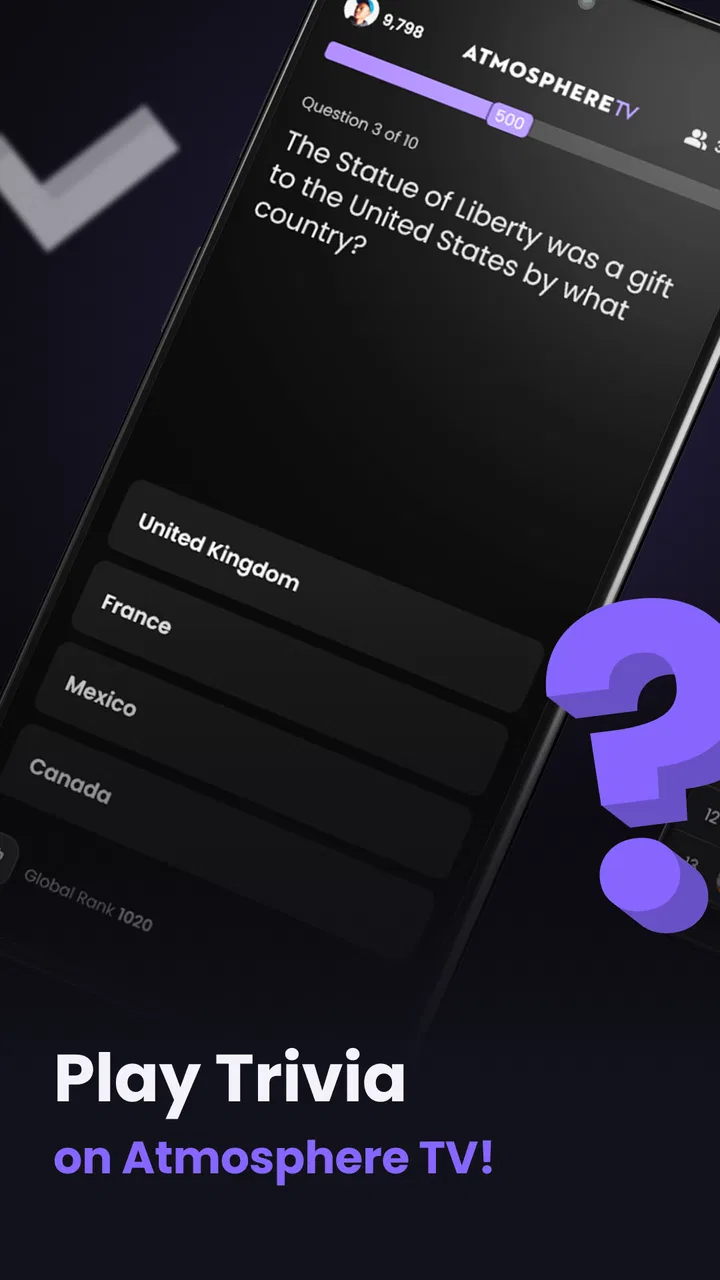
Atmosphere Trivia is the kind of game I would keep ready for an evening when nobody wants to commit to a long board game, but everyone still wants something more engaging than scrolling on a phone. It is a free trivia game from Rarefied Atmosphere, Inc., built around playing questions with friends and competing against people you consider your “nemeses.” After spending time with it, I found that its biggest strength is not complicated gameplay; it is how quickly it can turn a casual gathering into a shared challenge.
The game sits in the trivia category, with an Everyone content rating, so it is easy to suggest for mixed-age groups. It reached the store on October 9, 2023, and has grown to over 100 thousand installs. Its average rating is 4.6 from around 1.5 thousand ratings, which matches my general impression: the central idea is approachable and entertaining, although the experience depends heavily on the people playing and on whether the question flow suits the group.
How a normal game night with Atmosphere Trivia works
My preferred way to use Atmosphere Trivia is not as a solitary quiz that I play while waiting for something. It works better as a social layer for a real conversation. I can imagine opening it after dinner, passing the phone around, and letting each person answer while everyone else reacts. The questions give the group a shared focus without requiring anyone to learn a rulebook first.
You May Also Like

 AccuWeather: Weather Radar
AccuWeather Review: A Quick, Clear Forecast for Everyday Decisions
For everyday plans, the best forecast is the one you can understand quickly. AccuWeather makes rain timing, radar, and local conditions easy to act on, with a few trade-offs.

 Hill Climb Racing
Why Hill Climb Racing Still Turns Crashes Into One More Run
A tiny car, a bumpy hill and one more upgrade: Hill Climb Racing keeps resurfacing because its simple chaos makes every near-miss feel personal.

 AliExpress - Shopping App
AliExpress Makes Global Shopping Feel Personal, but Shoppers Bear the Risk
AliExpress turns a global marketplace into a pocket-sized discovery engine. Its reach is useful, its shopping loop compelling, and its trade-offs easy to miss.

 Lords Mobile: Kingdom Wars
Lords Mobile Is a Kingdom-Building Routine, Not a Quick Match
A case-by-case verdict on the building, battles, device demands, and social commitments that make Lords Mobile rewarding for some players and exhausting for others.

 PDF Scanner app - TapScanner
TapScanner Makes Paperwork Easier to Capture, Check, and Share
TapScanner makes scanning with a phone feel less like a rescue operation and more like a dependable step in getting work done. Its capture tools are useful, though not flawless.

 Block Blast!
 Shows How Much a Puzzle Game Can Leave Out
A quiet grid game shows why puzzle players increasingly value instant clarity, repeatable skill and low-pressure play—and where the genre still needs to catch up.
More From Our News Desk
View All News


The basic appeal is the rivalry. Calling another player a nemesis gives the session a little personality, especially when two people already have a history of arguing over obscure facts. That framing is more memorable than simply answering a sequence of anonymous questions. It encourages playful competition rather than making the game feel like a test.
I also like that the game can fill different amounts of time. A short session works when people are waiting for food or deciding what to do next. A longer session can become the main activity, provided the group remains interested in the subject matter. This flexibility is useful because trivia games often fail when they demand too much preparation for a small window of free time.
For a realistic everyday example, I would use it during a relaxed weekend visit with friends. One person starts the game, everyone keeps their own informal score, and the group pauses naturally to debate an answer or tell a related story. The best moments are not always the questions themselves. They are the arguments that follow a near miss, the surprising specialist in the room, and the person who confidently chooses the wrong answer.
That social setting matters. If you want a deep solo quiz with detailed explanations after every answer, this may not be the strongest choice. Its value comes from interaction, rivalry, and momentum. I would recommend it to people who want a light group game first and a knowledge challenge second.
What I would do before inviting everyone in
I would make sure the phone is charged, the screen is visible from where people are sitting, and the group agrees on how answers and scores will be handled. These sound like small details, but they prevent the familiar problem where the game pauses because nobody knows whose turn it is or who is keeping track.
I would also choose the players carefully. Atmosphere Trivia is more enjoyable when the group can laugh at wrong answers without turning every round into a serious contest. If one person dominates every subject, I would encourage the others to treat the session as a team challenge rather than a test of individual knowledge.
A useful habit is to decide in advance whether the group wants speed or discussion. If speed is the priority, answer promptly and move on. If the evening is more conversational, allow time for guesses and explanations. The game can support either mood, but the group should choose deliberately instead of letting one competitive player dictate the pace.
Settings, habits, and ways to make the experience smoother
There is no reason to rush past the game’s available setup screens. I make a point of checking the player arrangement and any visible options before starting a serious session. Even when a trivia game looks simple, a minute spent confirming the setup can save repeated interruptions later. This is especially useful when several people are sharing one device.
I would check the current version before relying on the game for a planned gathering. The version shown for Atmosphere Trivia is 1.8.2 (1529), and the minimum operating system is Android 8.0. That makes it accessible to many older Android phones, but compatibility still depends on the actual device and its condition. If I were hosting a party, I would open it beforehand rather than waiting until guests arrived.
The game is free, which removes the awkwardness of asking friends to buy the same title before they can participate. That makes it easier to suggest spontaneously. Still, free does not automatically mean frictionless. I would test the opening flow, confirm that the device is ready, and avoid assuming that every player will understand the setup instantly.
One practical technique is to appoint a temporary host. The host starts the session, reads or passes along the prompts, and keeps the group moving when discussion becomes too long. This does not change the game itself, but it improves the rhythm considerably. Without a host, everyone may reach for the phone at once or talk over the person trying to answer.
I also recommend separating “serious” and “casual” sessions. In a casual session, people can joke, challenge one another, and accept interruptions. In a serious session, the group should agree not to search for answers or use outside help. That distinction prevents disagreements about fairness and lets the same game serve two very different purposes.
Small choices that improve a shared-screen session
When I play with a group, I keep the phone in one consistent place instead of handing it to whoever speaks first. A central position makes the session feel more like a communal game and reduces accidental taps. It also lets everyone see the question without turning the activity into a contest over who controls the device.
I would avoid starting immediately after a loud conversation or while people are moving around the room. Trivia needs enough attention for everyone to hear the prompt and register the result. A quiet pause before the first round makes the game feel more deliberate and helps players settle into the rhythm.
Another useful habit is to treat the first few questions as a warm-up. I would not judge the whole experience by the opening minutes. Groups often need time to understand the pace, discover who is strongest in which subjects, and decide how much debate they want. Once those expectations are clear, the game becomes more natural.
For families, I would keep the atmosphere cooperative if younger players are involved. The Everyone rating makes the game suitable for a broad audience, but age suitability does not guarantee that every question will appeal equally to every person. Older players can explain unfamiliar references, while younger players may bring unexpected strengths in modern topics or visual memory.
Faster patterns for experienced players
After a few sessions, I stop thinking of each question as an isolated event. The better approach is to build a repeatable routine: listen fully, identify the subject area, make a quick first judgment, and then decide whether discussion is likely to improve the answer or merely create confusion. This keeps the game lively without turning it into a frantic race.
One of the most effective patterns is to give quieter players the first chance to respond. In many groups, the fastest speaker becomes the unofficial leader, even when that person is not the most knowledgeable. Rotating the first answer gives everyone a reason to stay engaged and makes the rivalry more balanced.
I also find it useful to separate confidence from certainty. A player who knows a subject well should explain the reasoning briefly, but the group should not treat confidence as proof. This is particularly important in trivia, where a familiar-sounding answer can be less reliable than a cautious guess from someone who remembers a small detail.
For close friends, the nemesis idea works best when it is used as a tactical social cue. Pair players who enjoy competing, but do not always put the same two people against each other. Changing the rivalry keeps the evening from becoming predictable and gives different personalities a chance to shine.
A second advanced habit is to use mistakes as information about the group. If everyone misses a question, that may reveal a subject that needs a little context rather than another argument. If one person repeatedly succeeds in a narrow area, let that player explain the answer after the round. The result becomes more educational without turning the game into a lecture.
I would not use external searches during a normal competitive session. Looking up an answer may settle a disagreement, but it also breaks the flow and rewards the person most willing to reach for another device. If a question produces a serious dispute, I prefer to mark it as unresolved and verify it after the session. That protects the pace while keeping the group honest.
When quick play is better than maximum accuracy
Trivia groups sometimes become too focused on proving every answer. I think Atmosphere Trivia is more enjoyable when the session keeps moving. If a disagreement is minor, accept the result and continue. Save detailed fact-checking for questions that genuinely affect the mood or the outcome.
This does not mean ignoring fairness. Before beginning, I would agree that everyone answers under the same conditions. The key is choosing a consistent standard. A group that allows long debates for one person but not another will lose the playful feeling that makes the game worthwhile.
Another speed improvement is to avoid restarting whenever somebody makes a small mistake in the setup. If the group can continue, continue. Constantly resetting a casual game creates more frustration than the original error. I reserve restarts for situations that genuinely prevent people from participating.
These habits are not hidden functions, and I would not pretend that they are. They are ways of using the game intelligently. The title supplies the prompts and the rivalry; the players supply the structure. Experienced users get more from it because they manage the social rhythm instead of expecting the app to solve every group dynamic automatically.
Where the game reaches its limits
The most important limitation is that Atmosphere Trivia cannot guarantee that every group will enjoy the same question mix. Trivia is personal. A subject that makes one player feel brilliant may leave another completely cold. That is not necessarily a flaw in the game, but it does mean the experience can vary sharply from one gathering to the next.
The shared-device format can also become awkward with a large group. People at the edge of the room may struggle to see the screen, and passing a phone around can interrupt the conversation. I would use it with a small, attentive group or position the device where everyone has a clear view. For a big party, a dedicated tabletop game or a display designed for group play may be more comfortable.
There is also a trade-off between accessibility and depth. The approachable structure makes it easy for newcomers to join, but players looking for a highly specialized quiz environment may eventually want something more focused. A dedicated subject app is a better choice for someone who wants only history, science, sport, or another narrow field.
Competitive players should be aware of the social risk too. The nemesis framing adds energy, but it can encourage one-upmanship if the group already has tense rivalries. I would skip this game for a gathering where people are likely to take wrong answers personally. A cooperative activity would be kinder in that situation.
Solo players may also find the experience less satisfying than a traditional single-player quiz. The game’s identity is tied to competing with others, so its strongest moments depend on reactions, teasing, and shared attention. If your main goal is quiet practice or measurable personal improvement, another trivia format may suit you better.
Device requirements are modest, with Android 8.0 listed as the minimum operating system, but older hardware can still affect comfort. A small screen, weak battery, or sluggish touch response will make a group session feel less polished. I would not blame the game for every problem, but I would choose the host device carefully.
Who should choose a different trivia game?
I would point serious quiz enthusiasts toward a more specialized alternative if they need extensive explanations, detailed progress tracking, or a carefully controlled competitive ladder. Atmosphere Trivia is better at creating a moment between people than at replacing a full study tool.
I would also suggest another option for players who dislike social pressure. Some trivia games are designed around private practice, where mistakes remain personal and the player can take as long as needed. This title is more appealing when being wrong is part of the entertainment.
On the other hand, people who want a free, low-commitment game for friends should give it a fair try. The lack of an entry price makes experimentation easy, and the Everyone rating means it can fit into family or mixed-age settings more readily than many competitive games.
My verdict after putting the routine together
Atmosphere Trivia is strongest when treated as a social game rather than a private examination. I would open it for a relaxed gathering, use the rivalry to give the session character, and rely on simple hosting habits to keep everyone involved. The app does not need complicated mechanics to be useful; its job is to provide enough structure for people to compete, laugh, and talk.
The developer, Rarefied Atmosphere, Inc., has positioned the game around a clear idea: turn ordinary trivia into a shared contest with personal stakes. In my experience, that idea works when the group is comfortable with friendly competition. The game feels less convincing when players expect a deep solo system or a perfectly tailored subject selection.
My practical recommendation is to prepare the device, agree on fair answering rules, rotate who speaks first, and avoid stopping the session for every disputed detail. Those four habits make a bigger difference than trying to optimize every answer. They also reveal the game’s real character: the software starts the challenge, but the people create the evening.
I would recommend it to friends who enjoy quick quizzes, playful rivalries, and games that can begin without much explanation. I would skip it for a large party, a highly competitive group that dislikes mistakes, or anyone searching for a serious study companion. For the right audience, though, this free trivia title is an easy addition to a game night and a surprisingly effective way to turn a quiet hour into something everyone remembers.
With its 4.6 average rating, growing audience, and straightforward premise, it has clearly found people who enjoy that balance of accessibility and competition. I would not call it the deepest trivia experience available, but depth is not really the point. My final view is simple: if you want a friendly challenge that gets people talking quickly, Atmosphere Trivia is worth installing and trying with the right group.
FAQs for Atmosphere Trivia
01What is Atmosphere Trivia and how does it work?
Atmosphere Trivia is an engaging mobile game designed to test your knowledge across various topics. Players answer questions from different categories, aiming to score points and climb the leaderboard. The app offers both solo and multiplayer modes, allowing users to compete with friends or other players globally. It’s perfect for trivia enthusiasts seeking a fun and educational challenge.
02Is Atmosphere Trivia free to play?
Yes, Atmosphere Trivia is free to download and play. However, it offers in-app purchases for additional features such as hints, extra lives, or ad-free experiences. While the core gameplay is accessible at no cost, these purchases can enhance your gaming experience by providing extra advantages.
03What are the main features of Atmosphere Trivia?
Atmosphere Trivia includes a variety of features such as multiple question categories, daily challenges, and leaderboard rankings. It also offers a multiplayer mode for competitive play, customizable avatars, and regular updates with new questions. The app's user-friendly interface ensures an enjoyable experience for all players, from beginners to trivia experts.
04Can I play Atmosphere Trivia offline?
No, Atmosphere Trivia requires an internet connection to function. This is necessary to access the latest questions, update leaderboards, and participate in multiplayer matches. While offline play is not supported, the app ensures a seamless and interactive experience when connected to the internet.
05What age group is Atmosphere Trivia suitable for?
Atmosphere Trivia is designed for a broad audience, generally suitable for players aged 12 and up. The app includes a variety of categories and question difficulties, making it appropriate for teenagers and adults. Parents should note that while the content is generally safe, supervision is recommended for younger players to ensure appropriate usage.
Pros
- Engaging questions keep players hooked.
- User-friendly interface is easy to navigate.
- Regular updates with new trivia categories.
- Multiplayer mode enhances competitiveness.
- Offline play available for solo practice.
Cons
- Ads can be intrusive during gameplay.
- Limited questions in niche categories.
- Occasional lag in multiplayer mode.
- In-app purchases can be pricey.
- Some questions lack depth or detail.

Atmosphere Trivia
Gallery